

In 2019, I beautifully discovered this book ’Vie, Mort et Ancestralité chez les Moba du Nord Togo’’ written by Dominique Guigbile with the collaboration of Pierre Erny. The book was published in June 2002 and talks about Moba people in North Togo, our conception of the world/beliefs, our societal/family structure, our traditions/cultural practices and so on. It really gives an array of details very VALUABLE, USEFUL, FASCINATING. And as always I am so thrilled, stimulated by the home-content and subject of the book but mostly, I am thankful to the authors for the book idea, which is today, helping me so much learn/know, understand, clarify some misunderstandings, rethink/re-examine more the (very little) knowledge and information I had about Moba culture, and re-affirm some of my positions against some practices and/or ideas etcetera.
And just like for LA SEXUALITÉ FÉMININE EN AFRIQUE: domination masculine et libération féminine by Sami Tchak, this post about the book is Part I (I surely can’t go through the book in One post 😛 ).
This first post will introduce a little bit of the essence of Moba people.
He mentions that Moba people’s conception of Space is conceptualized in concentric circles with at the center the house/home (p. 79). As per the book, there are 3 main religions existing for North Togo Moba people; Traditional religion (76%), Christianity (19%) and Islam (4%)(p. 86). As I am mostly interested in learning more about the traditional religion and also that it is, to me, the one that has less accessible information and knowledge, I will be talking more about that majority religion for Moba people. And so, the following information is sourced from the book.
In the Moba traditional religion, practices and beliefs are inherited as a result of belonging to a certain group. Therefore, there is no conversion needed, in order to become a practitioner of the religion and that the specific duties it requires, are also hereditary, not individual callings (p. 86). Each lineage has, then, its own place of worship. Interestingly, there is a mention about Moba traditional religion not being a religion of conquest.
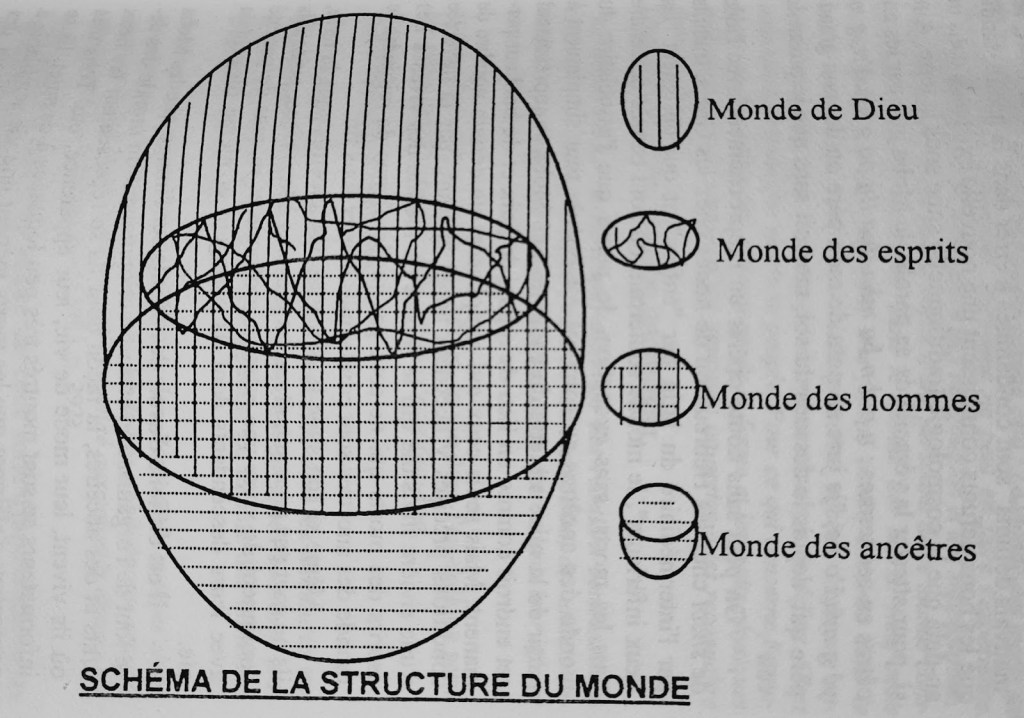
Jumping to the beliefs, representations and the conception of the world and of humans from Moba people. There is no detailed creationist conception of the origin of the world from Moba people, but there is definitely the belief of the existence of God, Yêdu, the supreme Being, creator and organizer of the world, of days and nights, of the alternation of seasons, master of life and death (p. 87). And the creation of the visible and invisible world has been attributed to him (p. 87). …However, it is believed that this one owes its existence to Yêdu (”God”) who has it as a great whole composed of three parts: the world above, abode of Yêdu; at the other extreme below, place of the abode of the dead and of the ancestors; finally, at the intersection of these two invisible worlds, the visible world in which live the humans (p. 94).
(June 28th 2022) As I felt that the initial post felt incomplete and there was something missing to it, I had/needed to add this additional part about Moba Ontology (all that is underlined in pink), which now makes me feel that the post is now complete 🙂
For Moba people, Yêdu is considered as very distant from men, the Moba populate the invisible universe with a multitude of intermediate beings, spirits, genies and ancestors. The latter, being closer to men, are the object of numerous domesticated cults and are at the heart of the relations that Moba maintains with the supreme being.’’(p. 87)…..He is beyond the time and space in which humans evolve. To reach him, they need the intermediaries of the ancestors and the spirits in charge of earthly affairs. The latter are not gods as some authors have long maintained in order to justify the (general) thesis of African polytheism.(p.94)
Among the Moba people, there is one supreme Being, the only one of his kind, creator of the universe and of humanity, dispenser of goods, source of order and cohesion in all things; but he is helped in the government of the visible world by his messengers and his lieutenants who are the ancestors and the spirits (p. 94).
From that invisible world, which escapes his grip, the Moba knows that he is born and dependent on it….It is on this complex vision of the world that the traditional religion of the Moba is based (p.98-99).
African societies in general do not have a simple conception like a dichotomous (‘’body-soul’’) or trichotomous type (‘’body-soul-spirit’’)…
The conception by Moba people, of the Human being, consists in a visible envelope, gbânâd (‘’flesh of the skin’’) or the body and multiple invisible elements, with some surviving beyond death (p. 100). The visible envelope, the body, thus appears to be formed by four substances: kpaba (bones), sôm (blood), gbânâd (the flesh) and nyum (water). It is then perceived as being the support of what is the essence of human beings.
However, the invisible elements are composed of at least 4 invisible principles: nalêŋ, fuom, cicili, cabl.
They are complex notions and can be difficult to grasp. I will try to explain them while remaining faithful to the explanation provided.
- Fuom is the breath of life, the vital force given to the human being. It is the principle that maintains the human being alive and enlivens. Its separation from the body means the immediate death of the being.
- Cicili ‘’could be translated to ‘’spirit’’. But Cicili is the plural noun and is always used that way, which suggests that the human being has more than one spirit’’. There is a whole page about the usefulness and role of Cicili, e.g., in relation to the ability to communicate with invisible forces.
- Nalêŋ (we can say) is a notion that is close to ‘’Dual’’. It is different from the ‘’Soul’’ notion in Christianity, as in Moba traditional religion, its separation from the body does not lead immediately to the death of the person(p. 101).
- Cabl is now what makes the specificity of the human being compared to the other living beings of the animal kingdom(p. 103). This component is according to the moba thought, the own essence of the human. By its nature and its role, Cabl is therefore closer to ‘’destiny’’. The thought being that each human comes into the world with a well-defined destiny, in some way, negotiated beforehand with God and including a mission to accomplish.
But the information about this latest component, makes one wonder: What can be said about the persons who harm one/nation in society, was that their Cabl? Does one’s, beforehand negotiated Cabl be harmful to a person/society/nation? Right after I asked myself the question, I came across this information that for me, answers the question: ‘’ A human is said to have a good cabl when he is successful in life, while misfortune is indicative of a bad cabl.’’ And what brings more explanation to this answer is that: ‘’ This principle (Cabl) which governs all of human‘s existence is an integral part of his being. A hidden reality which allows the individual to be identified, cabl is both the personification of destiny and the principle of luck.(p.103)’’
So it is luck, as well as destiny that Cabl is composed of. And there is so much that can be said about ‘’Luck’’, I will leave that to each their own. So back to the question, One that harms a person/society/nation is not necessarily his destiny, other factor/s impact that destiny.
To sum up in the vision of the world structure by the Moba people, there are four different worlds that exist; the world of God, the world of spirits, the world of humans and the world of the ancestors. All the last three worlds are an integral part of God’s world, within its definition, delimitations, boundaries. And although those three worlds are defined also, there are no definite delimitations among them, they intertwine, as it is the belief that spirits and ancestors can be invisible or visible to humans in the human world. As well as there are beliefs that each one can be a ‘’good’’ spirit or ancestor or a ‘’bad’’ one. Of course this belief raises interests and questions about how a spirit or ancestor is said to be bad or good, what processes is applied, who applies it and so on.
But I think I will leave these questionings for another post. And upon this first post, I am surely interested in learning more about the hereditary aspect of the practice of the traditional religion and the possible implication for a lineage successor who does not want to continue the duties of said traditional religion regardless/or not of the reason provided.
Philosophical and Theological questions: What can be said about the persons who harm one in the society, was that their cabl? Which will lead to wondering and asking: Is God good in the Moba traditional religion? Does one’s, beforehand negotiated cabl be harmful to a person and/or society? What does Moba traditional religion say on how Yêdu is?
NB: On page 29, there is this statement: << By speaking of ‘’traditional religions’’, we avoid the old names such as ‘’animism’’, ‘’fetishism’’, ‘’totemism’’, ‘’mânism’’, ‘’ancestrism’’, ‘’dynamism’’, etc., invented at a time when anthropologists with evolutionary tendencies were trying to identify the origins of religion. >>
Balg Bonciɛnn 🙏🏿
Thank you for caring, reading and sharing
Min Diɛ b – Yendu fin yen Balg
Disclaimer: The blog expresses MY person, not utterly a Whole community I personally affirm belonging to or utterly a Whole community other people may associate me with.
© Moba Maam 2021- 2024. Unauthorized use and/or duplication of this material without express and written permission from this blog’s author and/or owner is strictly prohibited. Excerpts and links may be used, provided that full and clear credit is given to Moba Maam with appropriate and specific direction to the original content.
Moba Maam reserves the right to change the terms and conditions hereof at any time.
Terms of services and privacy policy with WordPress.
 Moba Maam